Games
Noughts and crosses
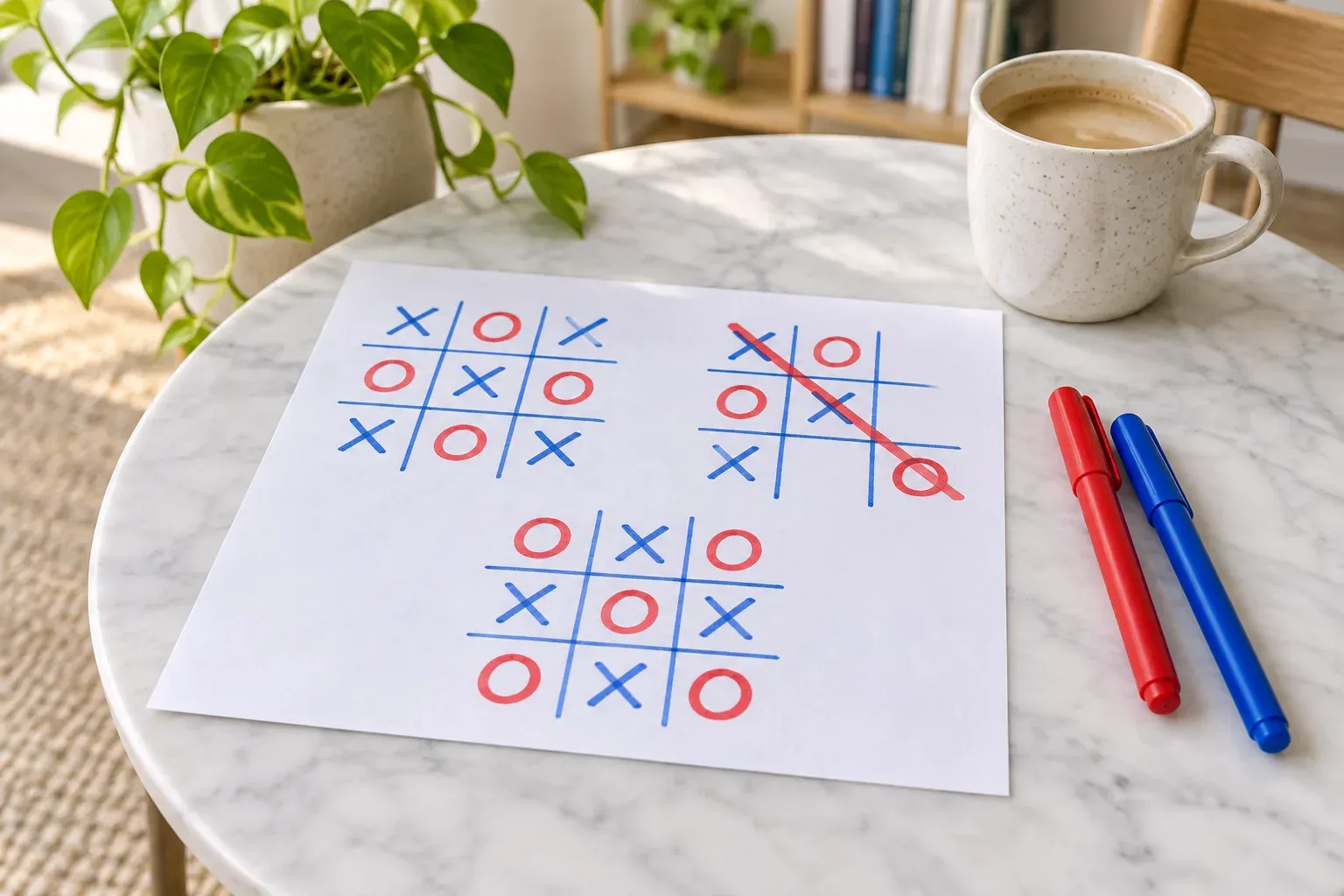
Draw a nine-square grid and take turns adding a nought or a cross, aiming for three in a row.
- Age
- 4 to 6 years
- Play time
- 15 min
- Set-up
- No prep
- Where
- Indoors or outdoors
- Who
- Any number of kids
- Clean-up
- Low mess
Four-year-olds play this enthusiastically and with no strategy whatsoever, which is lovely to watch. Somewhere around five or six the idea of blocking clicks, and suddenly they beat you. It is the classic café game, needing only a pen and a paper napkin or the back of a receipt. Letting them win a little helps early on, though most children work out surprisingly fast when you are going easy on them.
It is called tic-tac-toe in the US, and pavement is sidewalk.
How to play
-
Draw two lines down and two lines across a sheet of paper to make a grid of nine squares, each big enough to draw in.
-
Decide who is noughts and who is crosses. Giving each player their own colour of pen helps younger players see whose marks are whose.
-
Take turns drawing your mark in an empty square, letting your child go first.
-
The first to get three in a row, across, down or corner to corner, wins. If the grid fills with no winner, it is a draw.
-
Draw a new grid and swap who goes first.
-
To stretch it, play on a four-by-four grid aiming for four in a row, or talk through blocking: 'where do I need to go to stop you?'
What you need
- paper
- two colours of felt pen
Don't have it?
- No paper? Draw the grid in chalk on the pavement, or with a stick in sand.
What they are practising
- problem solving. Spotting where a row could be finished, and where to block one, means thinking a move ahead.
- turn taking. The game only works if each player waits for one mark at a time.
- fine motor. Drawing neat circles and crosses inside small squares takes some pen control.
Make it easier
For a four-year-old, use two colours and point out each row as it fills, showing where three in a row could still go.
Make it harder
A six-year-old can try never to lose by blocking every row, or play on a bigger grid with four in a row to win.
Parents ask
- Should I let my child win?
- Sometimes, especially at first, but real wins mean more to them. Try leaving an obvious gap now and then and see whether they spot it.
- Every game ends in a draw. Is that normal?
- Yes. Once both players know how to block, a draw is the usual result, and that is a good moment to try a bigger grid.
- Can we play without paper?
- Use chalk outside, a small whiteboard, or nine squares of masking tape on the floor with socks and cushions as the marks.
Find more like this
4 year olds5 year oldsIndoorsOutdoorsNo prepLow messGamesWith paper